Many systems have developed innovative functions to serve different operational needs for restaurants. With various new POS systems available on the market, how should restaurant owners choose one that could bring positive impact to your restaurant’s profitability and performance? We have summarised 5 key factors for you to consider when choosing the most effective POS system for your restaurant!
1. Understanding your restaurant's scale and needs
It’s essential to understand your restaurant scale and daily operational needs before you determine which features you want from your POS system. The features should align with your business goals and operational demands to ultimately improve business management, efficiency and profitability.
For instance, if your restaurant is a quick-service restaurant such as a fast-food shop, café or bar, you would want to look for a POS system with various payment platforms integrated to meet your customers’ needs of fast payment, and a membership management function to maintain customer loyalty and reduce customer acquisition cost.
If you run a midscale restaurant like a Cha chaan teng or global cuisine, kitchen and inventory management features would be your main focus to control food costs and prevent inventory shortages. For upscale restaurants, such as hotpot, buffets or fine-dining restaurants, you need a powerful POS system that offers features such as self-serve ordering with QR code, inventory management, reservation and queue management to streamline manual operations and arrangements to enhance the overall dining experience.
2. Consider the cost-effectiveness of the system
Pricing of F&B POS systems varies depending on the features provided and the equipment required, with prices ranging from hundreds to thousands of dollars, and payment plans can be one-time, monthly and annual, with each option having its own upside and downside.
While one-time payment avoids the trouble of monthly or annual payment, additional installation costs may be incurred for add-on features. Monthly or annual payment offers greater flexibility, enabling you to update, switch or terminate system features based on your business needs.
To maximise efficiency and cost effectiveness for your restaurant, you should examine your budget and determine whether the POS system's features and equipment can fulfil your restaurant's operational and management needs. Additionally, essential costs such as system setup, employee training, and maintenance and software update cost should also be considered.
3. Evaluate the system's usability and its hardware compatibility
A POS system with user-friendly interface and excellent hardware compatibility can help reduce employee training time, improve order accuracy and handle a higher volume of orders efficiently.
Nowadays, many F&B POS systems are compatible with portable hardware such as smartphone, iPad, kitchen printer and barcode scanner, making it easy for employees to take, modify and make orders in real-time to enhance the flow and accuracy of the entire order. In addition, it is also crucial to evaluate whether the system requires specific hardware such as cash registers or computers, which may impact system usability and employee efficiency.
4. Integration of takeaway platforms and payment systems
Takeaway is probably one of the main sources of income for many F&B businesses. If the POS system is integrated with popular takeaway platforms such as Deliveroo or foodpanda, it can help merchants to increase restaurant turnover and analyse takeaway revenue more clearly. There are also some F&B POS systems that connect to their self-developed takeaway platforms for merchants to consider.
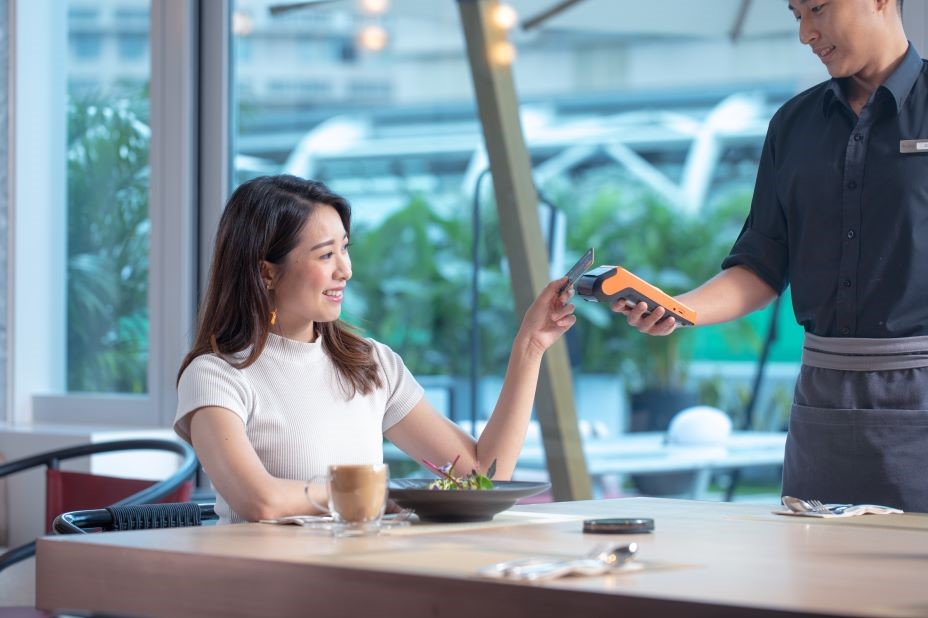
In addition to takeaway platforms, it's crucial to consider whether the POS system can integrate with third-party electronic payment systems. By integrating these payment systems, you can synchronise order and payment information in real-time, improve settlement accuracy, speed up the payment process, and allow customers to choose their preferred payment method. KPay Terminal Pro can easily integrate with KPay POS, enabling merchants to accept up to 20 major payment methods and boost restaurant competitiveness in a bustling marketplace.
5. Consider the reporting feature of the POS system
The reporting feature is also one of the key features of a POS system. A powerful and effective POS system should provide a real-time, precise and detailed report on sales and inventory etc., for restaurant owners and their managers to understand and grasp the overall situation of the restaurant effortlessly, and thus formulate better marketing and business strategies. You should pay attention to whether the data in the dashboard and report can be easily understood at a glance and provide valuable insight to improve your business performance.
When you consider switching to a new F&B POS system, it's crucial to evaluate your restaurant's type, scale, operational processes, and budget before making a decision. By considering the factors mentioned above, you will be able to select a POS system that aligns with all your business operations and development needs.
KPay POS for F&B businesses
KPay POS is integrated with the KPay ecosystem so that you can access all you need in one place. We help to streamline your business operations, so you can focus on what matters — delivering an exceptional dining experience.
KPay POS offers various features to help you run your business efficiently:
- From first order to final close-out — one system, zero gaps: Taking the order, printing to the kitchen, collecting payment, and closing out at the end of the day are all connected and automatic, so nothing falls through the cracks.
- Built for complex orders, not retrofitted: Drink and food customisation options such as removing specific ingredients, indicating your preference for milk type, sugar level and size are built into the order and priced automatically. What the counter takes is exactly what the kitchen makes.
- Your floor moves as fast as your team does: Transfer, merge, or clear tables with a tap. Every action updates instantly across the system, so front-of-house always knows what's available, occupied, and ready to seat.
- Every order accounted for, at a glance: Each order is tracked live from placement through to completion, so your team always knows what needs attention without chasing the kitchen or digging through receipts.
- Every shift starts clean, every variance caught early: At shift open, staff enter the starting cash and the system automatically cross-checks it against the previous day's closing balance, flagging any discrepancy on the spot. No more end-of-day surprises or manual reconciliation guesswork eating into your close-out time.
With 24/7 support by a professional team that will guide you through the process of selection for a POS system that suits your business needs and ensure seamless setup, you'll be able to ensure that your business workflows are made more efficient so you can focus on helping your business grow.




















.png)