Online business ideas in Hong Kong: What's actually working for SMEs
23 October 2026
10 min read
KPay Editorial Team
Making the complex sides of financial management, business operations and digital transformation simple. We share practical tips and local stories to help you run your business smarter and grow faster.
Key takeaways
Hong Kong's dense, mobile-first consumer market makes it one of the highest-potential environments in Asia for online business growth.
The strongest online business ideas for Hong Kong entrepreneurs include ecommerce, F&B delivery, digital services, social commerce, and Cantonese content.
Local payment expectations, such as FPS, PayMe, AlipayHK, WeChat Pay HK, and Visa/Mastercard, directly affect online conversion rates.
Seamless payment infrastructure is not a nice-to-have; it's the operational backbone of any sustainable online business.
You've thought about starting something online. Maybe it's a side income alongside your current job, a way to take your existing shop beyond its four walls, or an entirely new venture you've been turning over in your head for months. The problem isn't motivation, it's figuring out which online business idea is actually worth pursuing in a market like Hong Kong.
However, the answer isn't the same for everyone. Hong Kong's compact geography, mobile-first consumers, and proximity to Greater Bay Area supply chains create a specific set of conditions that make some online business models far more viable here than they would be elsewhere, while making others considerably harder.
This guide covers online business ideas that have genuine traction in Hong Kong, what it actually takes to make them work, and the operational infrastructure that separates businesses that scale from those that stall at the first friction point.
Why Hong Kong is a strong environment for online business
Hong Kong has one of the world's highest smartphone penetration rates. Consumers research products, compare prices, and complete purchases entirely on mobile often before stepping foot inside a physical shop. That means an online business here has access to a digitally comfortable audience from day one.
High retail rents also mean that starting a business with a physical shopfront carries real financial risk from day one. An online channel, whether that's a standalone ecommerce store, a social commerce presence, or a delivery-enabled food operation, lets you serve customers at scale without committing to a lease in Mong Kok or Central.
Post-pandemic consumer behaviour has accelerated the normalisation of digital payments too. Customers who once insisted on cash now pay via QR code without a second thought. For anyone launching an online business, the consumer side of the equation is more ready than it has ever been.
Online business ideas worth exploring in Hong Kong
1. Direct-to-consumer eCommerce
Selling products directly to consumers through your own online store, rather than through a marketplace, gives merchants control over pricing, customer data, and brand experience.
For Hong Kong merchants, this typically means launching a store on a hosted platform (Shopify, WooCommerce, or local alternatives), driving traffic through social media and search, and fulfilling orders via local logistics networks. For merchants who want to launch without a platform subscription or developer, KPay Shop mini lets you create a live storefront with local payments built in from the start — no code required.
What makes it viable in Hong Kong: The city's compact geography means same-day or next-day delivery is operationally achievable for most merchants. Consumer trust in card and e-wallet payments is high, which reduces checkout friction.
The challenge: Competition from HKTVmall and regional platforms like Taobao means standing out requires a clear brand proposition. Margins matter more when platform fees aren't absorbing fulfilment costs.
2. F&B delivery and cloud kitchen operations
The cloud kitchen model, where food is prepared for delivery-only, with no dine-in component, has gained traction in Hong Kong as a lower-overhead route into the F&B market. Established restaurants have also used delivery platforms to extend reach without expanding physical space.
What makes it viable in Hong Kong: High population density means a single kitchen in Kwun Tong or Cheung Sha Wan can reach tens of thousands of potential customers within a 3km radius. Platforms like Deliveroo and foodpanda provide built-in order infrastructure.
The challenge: Platform commission rates (typically 25–35%) compress margins significantly. Merchants who build a direct ordering channel via payment links or a dedicated ordering page can retain more revenue per transaction.
3. Online professional and consulting services
Accountants, lawyers, HR consultants, marketing freelancers, coaches, and tutors have all moved significant portions of their business online. For service-based businesses, an online model dramatically reduces location dependency.
What makes it viable in Hong Kong: Hong Kong's professional services sector is large, and appetite for quality remote expertise is well established. Billing and collection are straightforward where a payment link or invoice-based workflow handles most use cases.
The challenge: Client acquisition without referral networks takes time. Investment in content marketing or LinkedIn visibility tends to have a longer payback period than product-based businesses.
4. Digital products and content
Online courses, templates, design assets, photography licences, and downloadable guides are high-margin businesses with near-zero fulfilment costs. Hong Kong creators and educators have built sustainable income streams on platforms like Teachable, Gumroad, and YouTube.
What makes it viable in Hong Kong: Cantonese-language content is underserved relative to English and Mandarin content, which means a well-positioned creator targeting local business owners or professionals can build an audience with relatively little direct competition.
The challenge: Revenue takes time to build and is highly dependent on distribution — growing an audience is the primary constraint, not product creation.
5. Social commerce and group buying
Selling through Instagram, Facebook, or WhatsApp, often with pre-order or group-buy mechanics, is a proven model for independent fashion, beauty, food, and lifestyle merchants in Hong Kong.
What makes it viable in Hong Kong: Social commerce thrives in markets with high mobile usage and strong community shopping behaviour, both of which describe Hong Kong's consumer base. Low setup costs and direct customer relationships are significant advantages.
The challenge: Managing orders manually is unsustainable at scale. Merchants who rely on WhatsApp order intake and bank transfer payments often hit operational limits quickly. Payment links, QR code checkout, and automated order tracking become critical infrastructure as volume grows.
6. Reselling and dropshipping via local platforms
Sourcing products, often from wholesale markets in Sham Shui Po, or via supplier networks in the Greater Bay Area, and reselling online remains a viable entry point for merchants with limited capital. Dropshipping, where inventory is held by the supplier, lowers the risk further.
What makes it viable in Hong Kong: Proximity to manufacturing and wholesale networks in the Greater Bay Area gives Hong Kong merchants a sourcing advantage relative to Western markets. Carousell, Facebook Marketplace, and HKTVmall all support individual seller listings.
The challenge: Margins on commodity products are thin, and differentiation is difficult. Merchants who build a curated product angle or strong brand identity typically outperform those competing purely on price.
What makes an online business viable in Hong Kong
Across every business model above, two factors consistently separate merchants who grow from those who struggle: how they handle payments, and how quickly they access their revenue.
Hong Kong consumers expect a wide range of payment options. A checkout that accepts only Visa and Mastercard will lose customers who prefer to pay via FPS, PayMe, AlipayHK, or WeChat Pay HK. Every unsupported payment method is a friction point, and friction directly reduces conversion.
Settlement speed matters too. Online businesses often have cash flow pressure that physical retail doesn't — inventory needs to be replenished before revenue clears, or service projects are invoiced before payment arrives. Fast, predictable settlement cycles give merchants the working capital flexibility to operate without constant liquidity anxiety.
Building the right payment infrastructure
The payment setup required for an online business depends on the model, but the core requirements are broadly consistent:
eCommerce stores need a payment gateway that integrates with their platform and supports local e-wallets alongside cards.
Service businesses and freelancers need payment links they can send via email or WhatsApp, with clear status tracking.
Social commerce sellers need QR code checkout that works on mobile and doesn't require a separate app download.
F&B merchants selling directly need an ordering flow where payment and confirmation happen in one step.
For merchants building or expanding an online operation, having all payment channels under one settlement account simplifies reconciliation and speeds up access to revenue.
How KPay supports your online business
For Hong Kong merchants may want to create a fuss-free simple online store or who may want a single provider covering their full online payment setup for their dedicated online business, KPay offers:
KPay Shop mini
KPay Shop mini is a no-code eCommerce solution that lets merchants launch an online store — complete with product catalogue, shopping cart, and checkout — in four steps, with AI guiding the setup from start to finish. For merchants who are retail-first and new to selling online, it removes the biggest barrier to going digital: the time and complexity of building a store from scratch. Here is how KPay Shop mini helps merchants start selling online without the usual friction:
AI-guided store setup in four steps: Merchants go from zero to a live storefront by completing four steps — business settings, product creation, template selection, and site information. AI handles the heavy lifting at each stage, so no technical background is required.
AI-generated store design and banners: Upload brand guidelines or reference images, and AI generates a customised storefront template and banner to match.
Centralised product management: Once your store is live, manage your full product catalogue from one place. Add new products, update descriptions, adjust pricing (including both selling price and original price for sale display), toggle products active or inactive, and update inventory quantities — all without having to leave the same page.
One activation, 15+ local payment methods: Merchants can start accepting card payments, Apple Pay, Google Pay, WeChat Pay HK, and AlipayHK simultaneously without the hassle of separate applications and integrations.
Your own branded storefront domain: Every KPay Shop mini store comes with a dedicated domain. Merchants who want a fully branded URL can apply for a custom domain and connect it to their storefront.
KPay Payment Link
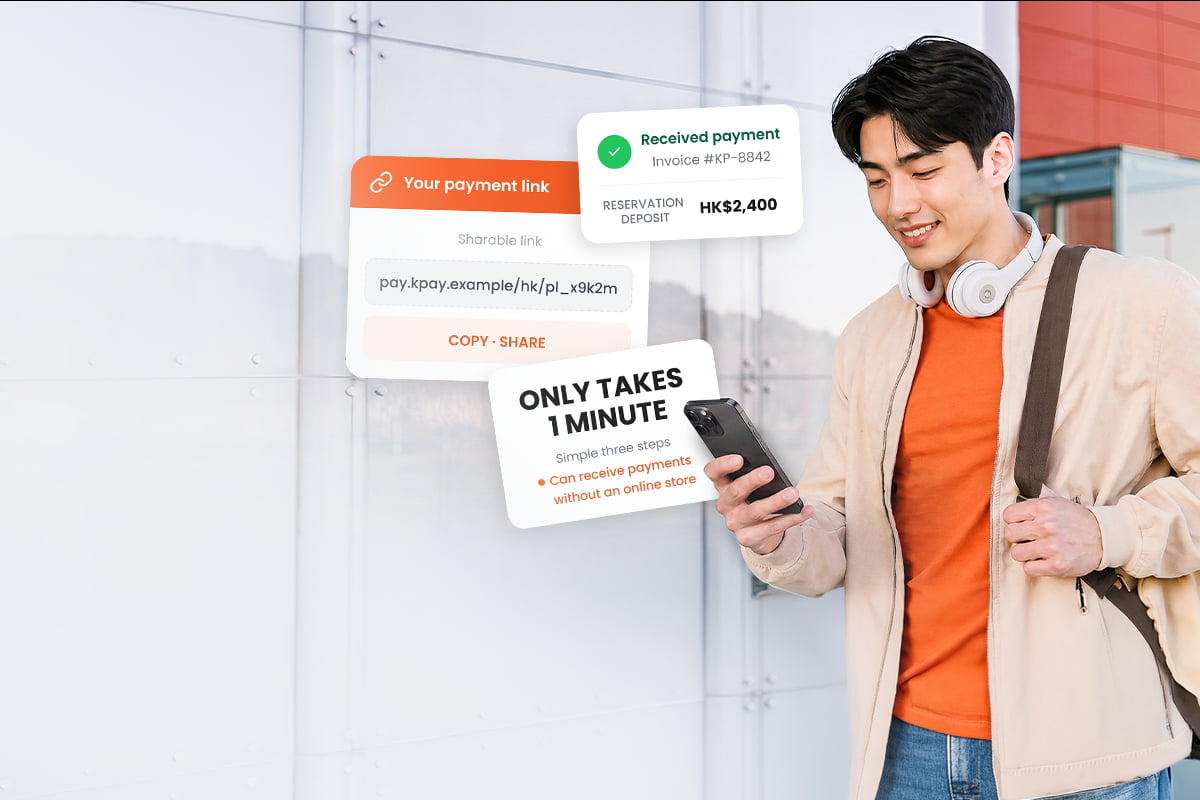
KPay Payment Link allows merchants to accept payments anytime and anywhere, without requiring a website or complicated technical setup. Merchants are able to make the checkout process a smooth one through:
Instant link-generation and sharing: Create and share secure payment links instantly via WhatsApp, Instagram or email. Turn any chat into a checkout page.
Long-lasting links with high-limits: Accept payments up to HK$50,000 per transaction, with links valid for up to 30 days, making it a good choice for high-ticket items and pre-orders.
Single or unlimited use of payment links: Choose whether a payment link is to be used once or repeatedly for unlimited payments based on your business needs.
Customisable payment amounts: When creating a payment link, merchants can choose whether to create a payment link with a merchant-set amount or to enable customers to key in their own amount to be paid:
Merchant-set amount
Merchants set a fixed payment amount for customers to pay directly, with no changes allowed.
Suitable for deposit collection, fixed-price products, and event registration fees.
Customer-entered amount
Customers enter their own payment amount, while merchants can set an acceptable payment range.
Suitable for flexible pricing, balance payments, and social commerce scenarios with multiple products and variant.
Pause and resume payments anytime: Merchants can set a payment link to “Paused” at any time to stop accepting payments, and click “Resume” to start accepting payments again whenever needed. Easily adapt and adjust the payment status in real time to suit your business needs.
Role-based access and control: Assign specific staff roles via the KPay App/KPay Dashboard to manage Payment Link creation and transaction visibility, ensuring that your business operations remain secure. This means that you can set access for staff to only create Payment Links without the ability to view and export transaction details.
KPay eCommerce Payment Plugin
For merchants who have an existing Wordpress and WooCommerce store, KPay's eCommerce Payment Plugin can help to make your checkout process a smooth one through:
Quick integration without the need for coding: Specifically optimised for the Wordpress and WooCommerce environment, merchants can seamlessly connect their existing website to KPay’s unified payment system by simply importing the plugin.
Staying ahead with hands-free updates: As payment technologies evolve, KPay will be responsible for ongoing maintenance, security patches, and functional upgrades. Merchants can ensure their checkout system remains in peak condition without the need to hire dedicated developers.
KPay Payment Gateway
KPay Payment Gateway gives online merchants a fast, secure, and flexible payment experience — removing the complexity often faced during integration and reducing the number of failed transactions. Here is how KPay's Payment Gateway can help businesses to focus on converting customers instead of fixing payment problems:
3 integration modes: With 3 different integration modes — "all-hosted page", "hosted page", and "full API integration", merchants have the flexibility of choosing a solution that meets their business needs.
15+ major payment methods, one integration: For businesses using "all hosted mode", you can accept major credit and debit cards, e-wallets, and local payment methods across Hong Kong, Mainland China and beyond from a single unified checkout.
Launch with professional support: KPay provides a complete walk-through and full developer documentation during integration and onboarding to ensure that your journey, and KPay ensures PCI compliance, along with centralised reporting via one dashboard.
Enterprise-grade security: KPay is ISO 27001 certified, attained PCI DSS Level 1, is backed by HSBC partnership and holds regional operating licenses across multiple regions such as Hong Kong, Australia and Singapore.
Whether you're setting up for the first time or consolidating a fragmented payment setup, KPay's team can help you identify the right configuration for your business model.
Common challenges when taking a Hong Kong business online
Payment fragmentation: Managing separate accounts for card payments, FPS, and e-wallets creates reconciliation complexity. A unified payment solution reduces this significantly.
Platform vs. direct tension: Marketplace platforms deliver traffic but erode margins. Building a direct channel alongside marketplace presence, even modestly, protects long-term profitability.
Trust signals: Hong Kong consumers are price-sensitive but also cautious about fraud. Clear business registration, transparent refund policies, and professional checkout experiences all contribute to conversion.
Logistics: For product-based businesses, reliable last-mile delivery is non-negotiable. Courier integrations and clear shipping communication directly affect repeat purchase rates.
Practical steps to get started
Choose a model that fits your existing strengths: A restaurant pivoting to delivery has different infrastructure needs than a consultant launching an online course.
Register your business properly: A valid Business Registration (BR) builds consumer trust and is required for merchant account applications.
Set up a payment infrastructure that matches how your customers want to pay: Don't assume card-only is sufficient for a Hong Kong audience.
Start with a small catalogue or limited service offering: Validate demand before scaling overhead.
Build a direct customer relationship early: Email lists, WhatsApp broadcast lists, or CRM tools protect your business from platform dependency.
Frequently asked questions
What online business can I start with little money in Hong Kong?
Service-based businesses (consulting, tutoring, freelance work) and digital product businesses (online courses, templates, content) have the lowest startup costs. Social commerce selling via Instagram or WhatsApp is also accessible with minimal upfront investment. Instead, the main overhead is time and product sourcing.
Do I need a business registration to sell online in Hong Kong?
Any sustained commercial activity in Hong Kong typically requires a valid Business Registration Certificate issued by the Inland Revenue Department. Operators should verify requirements with a professional adviser or the IRD directly.
Which payment methods do Hong Kong online shoppers prefer?
HK consumers use a mix of credit/debit cards, FPS, PayMe, AlipayHK, and WeChat Pay HK. Offering multiple options is strongly advisable for any merchant targeting local customers.
What's the difference between a payment gateway and a payment link?
A payment gateway integrates directly into a website checkout flow. A payment link is a shareable URL that leads to a hosted payment page — simpler to deploy and useful for service businesses, social commerce sellers, or anyone invoicing clients directly.
How quickly can I access my online sales revenue?
Settlement timelines vary by payment provider. For KPay merchants with a KPay Business Account, you can opt for Everyday Settlement where you can receive your funds every single day, including weekends and public holidays. We ensure your funds reach your KBA account 365 days a year, rain or shine.
Turn your online business idea into something that actually runs
The idea is the easy part, and it's also the part everyone else has. What separates the merchants who build something sustainable is how seriously they take the operational side from the start.
If you're exploring how to build or expand your online presence in Hong Kong, KPay's team works with SMEs across retail, F&B, and services to set up the payment infrastructure that makes online commerce actually work.